
Forget Keywords: Concentrate on These 3 Marketing Tactics
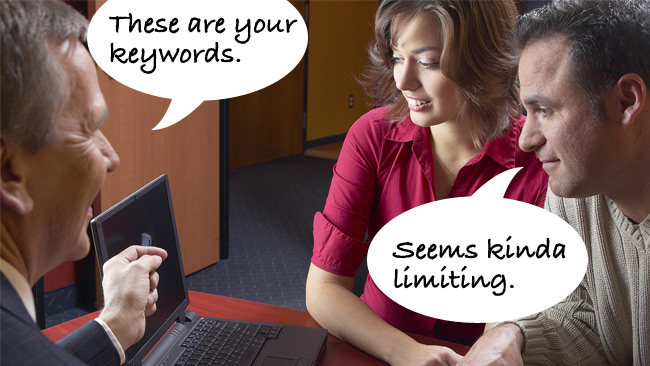
Sorry to burst your bubble. Your keywords don't matter anymore. Stop obsessing over them and move on. You're behind and need to catch up with the rest of us. Ready? Let's go.
Inadvertently, you've been limiting your business all these years. Yes you, the business owner, marketer, entrepreneur. Whatever you may call yourself. By thinking in terms of keywords, you've missed out on reaching potential customers. This rigid thinking must end. You'll do so much better at promoting your business online, if you start concentrating on these three areas:
Increasing Creative Output
Because social signals (likes, shares, retweets, plus ones, etc.) are increasing in importance, pursuing the viral aspect of a social network will help spread the word by none other than your loyal fans, aka your customers.
We've all heard about the effectiveness of video, but that's not the only shareable content you have. PowerPoint presentations can be repurposed on SlideShare and find new life on LinkedIn. Pin high quality images on Pinterest and capture the eye of interested parties. Inform as well as entertain your audience by showcasing data and statistics through the use of infographics.
Embracing the Semantic Web
No, not satanic. The Semantic web supports "a vision of information that can be readily interpreted by machines, so machines can perform more of the tedious work involved in finding, combining, and acting upon information on the web." Basically, it provides context upon which the technology at hand can better interpret, who, what, where, when, how and why.
Google has begun pushing forward the semantic web by positioning Google+ as the successor of Facebook. You've seen a bit of it as more and more Plus profiles are showcased in your search results. Bing has even countered Google by incorporating Facebook elements in its search results.
Supporting Responsive Design
A growing movement among marketers and designers is the use of responsive design, "which consists of a mix of flexible grids and layouts, images and an intelligent use of CSS media queries." The movement is in response to the growing mobile market pushed by the development of the smartphone and the tablet.
Now, a separate mobile version of your website is one way of addressing multiple device needs. Of course, device specific design requires multiple designs and twice the amount of time. Eventually with responsive design, web design companies will be able to develop it once and let the device determine the best layout. Though obstacles still exist when implementing and not all websites work well with responsive design, the technology will grow and the benefits will eventually outweigh the negatives.
BONUS: Embrace Your Website's Analytics
If your website's content management software doesn't include visitor profile analytics, you're losing out on valuable information about your visitors. Rather than guessing what visitors may be interested in, analytics provides detailed information about when most people visit, where they came from, the most popular pages viewed, how long they stayed, downloads, purchases and more. From this data, you can edit and update non-performing web pages as well as the checkout process to help increase your sales.
There you have it. Three simple and necessary marketing tactics for a more successful online presence.




|
|

You can now get a professionally designed website for free! Check out the free website offer and get your website powered by BannerOS. BannerOS is free to try for 30 days.
Popular Articles
Build Brand Awareness Via Youth Sports
Seminar Success: From The Back Row
10 Tips For Better App Development
4 Ways To Build Virtual Connections Online to Boost Your Business
Categories
Download
 Whitepapers, Infographics, & Quick Guides
What Email Campaign Schedules Generate the Most ROI?
Which Content Marketing Strategies Get the Best ROI?
Which Social Media Marketing Strategies Work Best?
Benefits of a Fully Functional & Optimized Website