
Phil Simon Explains Why Businesses Fail to Communicate

Communication is a necessary component in the success of any business. You'd think that with all the ways technology now allows us to engage with each other, it would be easy. Unfortunately, that is not the case according to Phil Simon, noted author and recognized authority on technology, trends, communication, and management. Our Assistant Marketing Manager, Brian Mell talked with Phil about his upcoming book on this hot topic.
Your new book, Message Not Received: How New Technologies and Simpler Language Can Fix Your Business Communications discusses missed opportunities to communicate in business. What prompted you to pursue this topic? 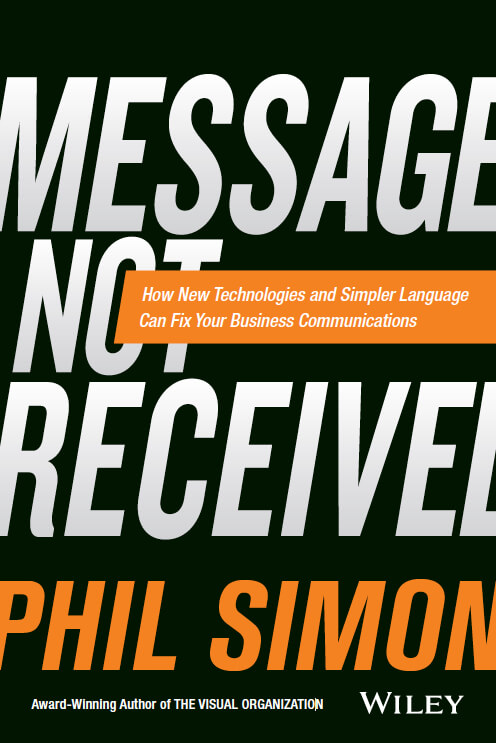 I’ve been passionate about language for my entire life. I’ve seen firsthand how poor communication has adversely affected projects, people, and organizations. I’ve also seen the problem exacerbate as of late and with no end in sight. We are deluged by e-mails, jargon and, put simply, this doesn’t need to be the case. Actually speaking to each other in plan, simple language can be remarkably effective. Unfortunately, many of us tend to forget this. In short, how we’re working isn’t working. I felt compelled to write about the topic.
What are you trying to achieve with this book? I hope that Message Not Received ignites a conversation about how we communicate. I’d like people to question why they use jargon and why the default mode of communication is e-mail. I’d like to see the book’s case studies spark discussion inside of large and small companies.
In general, how has the Web changed or evolved business communications over the past five years? It’s both very different and very similar. Let me explain. On a personal level, communication now take place across a wide variety of mediums: e-mail, text, private message (e.g., Snapchat and their like), Twitter DM, instant messages, social networks, blog comments, and old-fashioned phone calls. The number of ways to get in touch with a friend is mindboggling. Professionally speaking, though, most of us tend to rely upon the Web’s killer app: e-mail—and this shows no signs of abating. We are receiving 100 to 150 e-mails per day, a number that is growing by about 15 percent per year. This is regrettable. There are far superior tools for communication and collaboration like Asana, Dropbox, Yammer, and scores of others. Organizations that embrace these new tools are at a decided advantage over their counterparts.
How can (or should) a website and/or website platform play a part in a company’s business communication? It’s the single easiest way to provide information and valuable content. A little advertising is acceptable and even expected, but far too many companies use their websites as de facto brochures. There’s nothing really of substance. I’ll often go to a website, pull the contact information that I need, and never return. With Google, Yelp, and other sites, I don’t even need to go to a site. The most intelligent companies use their websites to engage in conversations with their customers, even if the latter never purchase anything.
Given that most people seem to still heavily rely on e-mail, what can a company do to get its employees and/or customers to adapt? Well, read the book. All kidding aside, it’s not simply a matter of buying and deploying the latest tool. We’ve seen that movie before and we know how it turns out. “Culture eats strategy for breakfast”, as Peter Drucker said. Organizations have to hold employees accountable for their actions. CXOs who espouse the benefits of new collaboration and communication tools—and then promptly fail to use them—set horrible examples throughout the organization. Beyond the top-down approach, organizations should listen to their employees. If a group is using Yammer, Asana, Slack, and Jive, they might want to consider wider deployments.
Should companies allow employees to use personal social media accounts and computing devices for their job? Organizations really can’t stop their employees. Websenses and their ilk are wholly ineffective in an era of BYOD (bring your own device). You simply can’t prevent people from tweeting, liking, and sharing at work. Against that backdrop, there’s tremendous opportunity. Employees can engage with customers on Twitter, Facebook, and the like. Social media is not just for talking. It’s for listening and responding to problems before they become crisis. Just ask United.
Lastly, what do you see happening in the next year or two that will help how we communicate? Gradually, companies are realizing that there is life beyond e-mail. Klick Health (profiled in the book) is a case in point. I suspect that more organizations will embrace these new tools. I do worry, though, about the increasing use of business jargon. No matter the communications medium, language replete with buzzwords only confuses people.
 Phil Simon is a sought-after speaker and recognized authority on technology, trends, communication, and management. He advises companies on how to optimize their use of technology has written six books. His contributions have been featured in Harvard Business Review, CNN, Inc. Magazine, The New York Times, Wired, NBC, CNBC, Wired, The Huffington Post, Fast Company, abcnews.com, forbes.com, BusinessWeek, and many other high-profile media outlets. He holds degrees from Carnegie Mellon University and Cornell University.
Popular Articles
Discovering the Stonk Bin: Your Gateway to Timely Stock Tips from BannerView.com
Quick Start Guide to Effective Pay-Per-Click (PPC) Advertising
Seminar Success: From The Back Row
Google's Pending (Mobile) Algorithm Change and its Effect on your Website
How to Sell Your Products on Instagram in the Instagram Marketplace
Categories
Download
 Whitepapers, Infographics, & Quick Guides
What Email Campaign Schedules Generate the Most ROI?
Which Content Marketing Strategies Get the Best ROI?
Which Social Media Marketing Strategies Work Best?
Benefits of a Fully Functional & Optimized Website